Pricing your first piece, when nobody knows your name yet
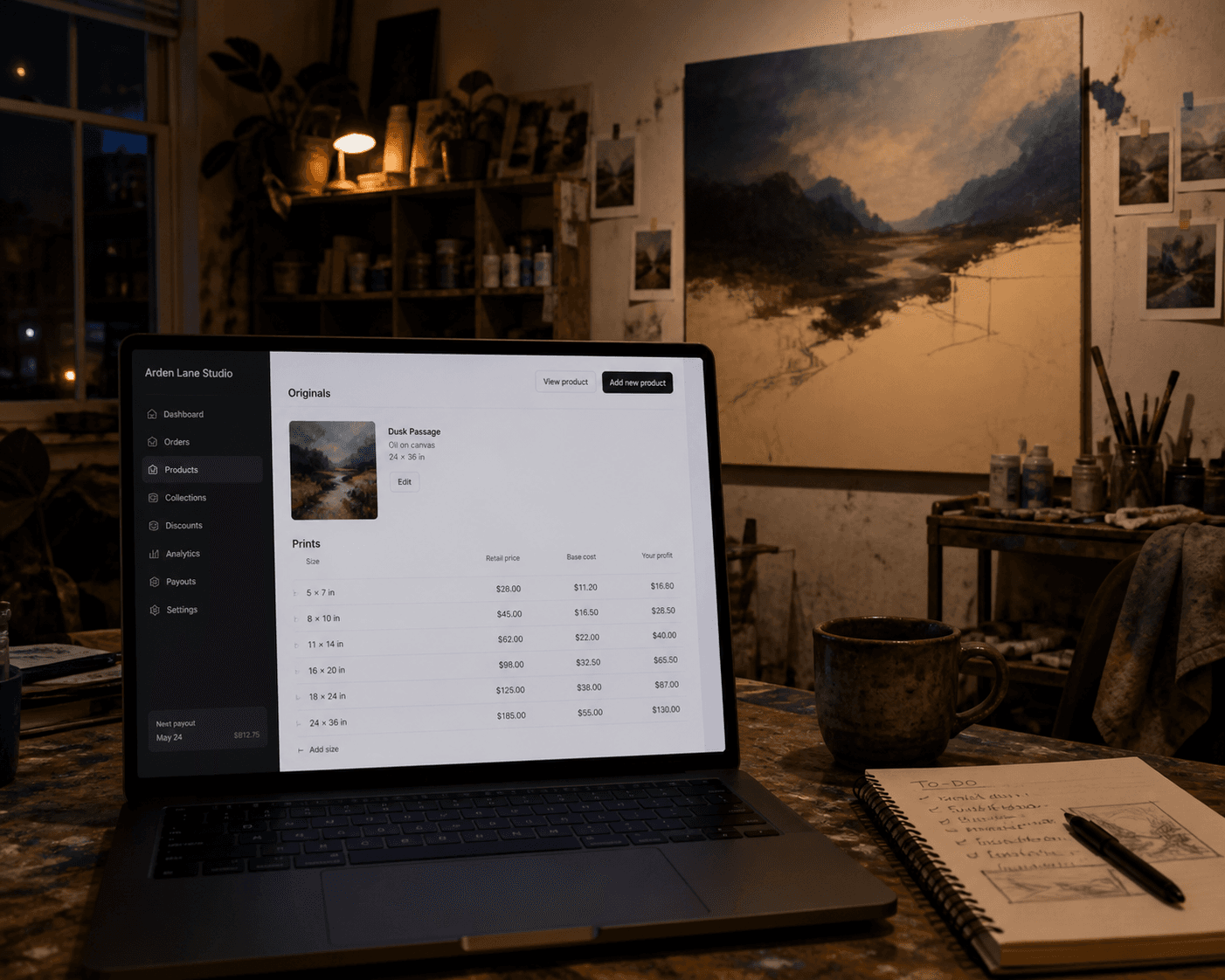
There's a moment every new artist knows. The artwork is leaning against the wall, finally finished. The photos for the webshop and social media are good. And there's a little empty box on the screen that says "Price."
And the cursor blinks.
Too low and you've spent six weeks on something that paid less than a weekend bar shift. Too high and the piece sits on the website for a year, quietly making you doubt yourself every time you open the dashboard. Neither feels survivable.
So you stare at the box. You think about the canvas, the paint, the hours (you stopped counting at thirty). You think about that artist on Instagram with 40k followers who sells similar-sized work for $2,500. You think about your friend's mum who said "oh my god you should sell that" and you have absolutely no idea if she meant $80 or $8,000.
Welcome. This is the first-pricing problem, and it's almost universal among artists who don't yet have a name.
What this post will not do
It won't tell you what your work is worth. Nobody can tell you that, including you, which is part of the problem. What it can do is hand you the formulas working artists and small galleries actually use as starting points, the rough multipliers for someone in your position, and the reasoning behind why they look the way they do. From there, you adjust.
The two rules of thumb everyone uses
There are two pricing formulas that have circulated through art schools, gallery back offices, and artist business books for at least the last twenty years. They're both imperfect. Both are also better than guessing.
Formula 1: Linear (width plus height)
(width+height) x multiplier = price
You add the two dimensions together and multiply by a number that reflects where you are in your career.
For a 50 × 70 cm canvas, that's 120 × multiplier. For a 20 × 28 inch canvas, that's 48 × multiplier.
This is the formula most commonly used in Europe, and it's the one to start with if you're new. Why? Because it scales gradually. A piece twice the size doesn't cost four times as much. The math feels reasonable to buyers, and it stops you from accidentally pricing your bigger paintings into a market that doesn't exist for an unknown artist.
Formula 2: Square (width times height)
Width x height x multiplier = price
Same dimensions, multiplied together instead of added. For that 50 × 70 cm canvas: 3,500 × multiplier. For a 20 × 28 inch canvas: 560 × multiplier.
This formula is used more in North America. It rewards larger work more aggressively, which makes sense for established artists where larger pieces really do command much higher prices. For someone selling their first piece, it can produce numbers that scare buyers off.
Pick one and stick with it across your whole catalogue. Mixing formulas is how you end up with a 30 × 40 cm priced suspiciously low next to a 100 × 120 cm priced suspiciously high. Buyers notice. They don't say anything. They just don't buy.
The multiplier is the whole game
The formula is trivial. The multiplier is where everything actually lives.
Here's a rough range that holds up across most Western art markets in 2026:
Linear formula (cm), in USD:
- Emerging artists, no real sales history: $4 to $8
- More established, regular sales, some recognition: $10 to $18
- Artists with a name in their region or specialty: $20 to $40
- Beyond that, you're not reading this post. The market sets your price for you.
Square formula (square inch), in USD:
- Emerging: $1 to $2
- More established: $2.50 to $4
- With a name: $5 to $8
A worked example on a 50 × 70 cm canvas (roughly 20 × 28 inches), emerging artist:
- Linear: (50 + 70) × $5 = $600
- Square: (20 × 28) × $1.50 = $840
Both land in the same neighborhood, which is a good sign. The piece is roughly a $700 painting. That's a defensible number you can put on your webshop without flinching.
For European and Nordic artists, the same logic applies, just with local multipliers. Rough emerging-artist ranges using the linear cm formula:
- EUR: 4 to 7 per linear cm
- DKK: 30 to 50 per linear cm
- NOK: 40 to 60 per linear cm
- SEK: 35 to 55 per linear cm
That same 50 × 70 cm canvas, emerging artist, comes out to roughly €600 or 5,000 DKK.
Why "low" doesn't mean "make it cheap"
There's a tempting logic that goes: I'm new, so I should price low to get sales. It almost works. The problem is the second sale.
Pricing too low signals two things to buyers, neither of which you want. First, it suggests you don't believe in the work yourself. Second, it locks you into a starting point you'll have to climb out of, which is much harder than climbing up from a fair starting point. Lowering prices later alienates the early buyers who paid the original price. Raising prices later from a low base feels desperate. Starting at a defensible number and holding it for a year is the move.
There's a piece of advice from artists' business consultant Alyson Stanfield that gets passed around for good reason: it's always a better business move to raise your prices than to lower them. Start where you can credibly stay for a while.
What the formula doesn't include (and why you have to add it)
Both formulas give you a base price. They don't account for:
Materials. If you've spent $150 on a high-quality linen canvas, oils, and varnish, that needs to be on top, not absorbed. Some artists double their material cost and add it to the formula price. That's a reasonable habit.
Gallery commission. If your piece will sell through a gallery, they take 40 to 50 percent. Your webshop price and your gallery price for the same piece have to match. Which means if you want $700 in your pocket from a gallery sale, the gallery price needs to be closer to $1,400. Some artists pretend this isn't true and price low everywhere. Then they get gallery representation and discover their entire price list needs rebuilding. Plan for the gallery from day one even if you don't have one yet.
Time. If something took you eighty hours and the formula gives you $700, that's under $9 an hour before materials. The formula is a market sanity check, not a wage calculation. Some pieces will be undersold by it, and that's a real cost you absorb in exchange for consistent, defensible pricing across your catalogue.
The check that matters more than the formula
Once you have a number, do this: open up Instagram or your favourite art platform and find five artists at roughly your career level, working in roughly your medium, in roughly your region. Look at their prices for similar-sized work.
If your number is way above theirs, lower your multiplier. If your number is way below theirs, raise your multiplier. If your number is in the same neighborhood, you're done.
This is the single most useful step in the whole exercise, and it's the one most beginning artists skip because it feels uncomfortable. Do it anyway. Pricing in isolation is how you end up either wildly underselling or pricing yourself into a market that doesn't include you yet.
The hesitant buyer problem
There's one piece of the pricing puzzle that has nothing to do with formulas and everything to do with the buyer's nerves. They love the piece. They've zoomed in on the photo three times. They want it. And then they think: but what if it doesn't work on the wall? What if it's smaller than I imagined? What if I get it home and it just looks wrong?
So they leave the tab open for two weeks. Then they close it.
This is one of the biggest invisible drags on online art sales, and it's worse for unknown artists because the buyer can't fall back on "well, the artist is famous so it'll be fine." They need to be able to picture it. Specifically. On their wall. At real size.
The fix is letting them do exactly that. (Blenda turns any artwork link into a preview the buyer can hold up to their actual wall, on their phone, no app needed. Which means the "what if it doesn't work" question gets answered before they hesitate themselves out of the sale.)
So, what do you put in the box?
Pick a formula. Pick a multiplier in the emerging range. Run the math. Sense-check it against five artists at your level. Adjust if you need to. Hold the price for a year, then revisit.
The number won't be perfect. It can't be. But it will be defensible, it will be consistent across your catalogue, and it will let you stop staring at that blinking cursor at midnight.
Which is the only thing the formula was ever really for.

FAQ
How should I price my first artwork?
Start with materials plus your honest hours at a modest rate, then sanity-check against artists at your career stage who actually sell, not against what people list. The test is simple: can you explain the number out loud without flinching?
Is it better to price too low or too high when starting out?
They fail differently. Too low reads as doubt in your own work; absurdly high reads as fantasy. A defensible middle number you can say with a straight face beats both.
When should I raise my prices?
After you've sold consistently at the current level, and gradually. Never lower prices publicly; the collector who paid full price last year will notice, and that trust doesn't come back.