Print on demand vs printing in-house: what the margins actually look like
Petra runs a poster shop out of Amsterdam. Every Sunday night, she opens the same two browser tabs. One is her Printful dashboard. The other is a quote from a print shop in Zaandam offering her 50 test posters for 340 euros.
She has run this exact comparison eleven times this year. She still isn't sure which option is actually making her money.
That's the print on demand versus in-house question in one sentence. It looks like a printing decision. It's actually a margin decision, and most shop owners are staring at the wrong numbers when they try to make it.
The real question isn't "which is cheaper"
Print on demand and in-house printing don't really compete on quality anymore. Most POD providers (Printful, Prodigi, Gelato) run professional giclee-grade large format printers, the same category of equipment a small in-house operation would buy. The paper stocks overlap too.
What they compete on is risk versus margin. POD sells you certainty: no upfront equipment, no unsold inventory, no Tuesday afternoon spent unjamming a printer. In exchange, it caps how much of each sale you actually keep. In-house flips that trade. More risk up front, a wider margin once you clear it.
So the question isn't which is cheaper per unit. It's: at what order volume does the switch pay for itself, and what are you actually buying with the fee you pay POD to make that risk disappear?

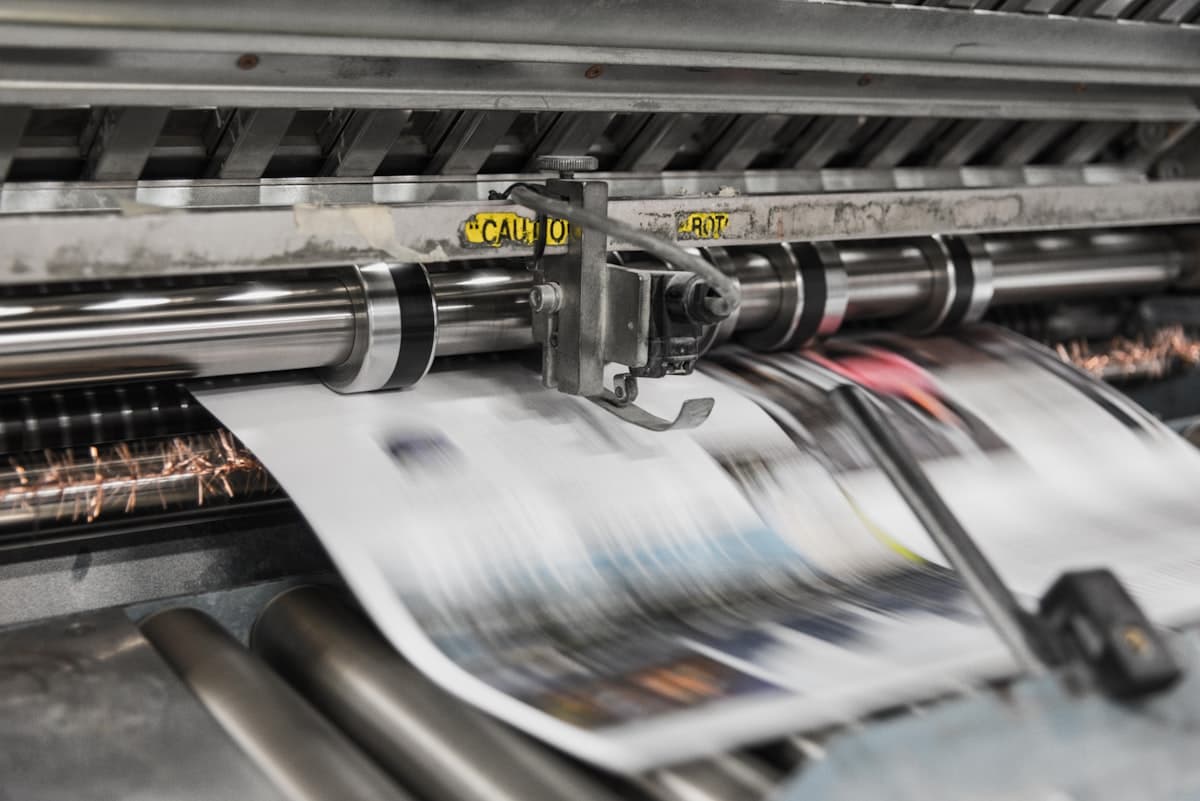
Photo by Alberto Rodríguez on Unsplash
What the numbers actually look like
A 50x70cm poster through a POD provider typically wholesales somewhere between 18 and 26 euros, print plus a domestic shipping label included. Sell it at 40 to 45 euros and you're keeping roughly 40 to 50 percent, with zero money spent before the order lands.
In-house changes the shape of the cost entirely. A large-format printer capable of gallery-quality posters runs anywhere from 3,000 to 9,000 euros depending on width and ink system. Add a paper trimmer, storage racks, and packaging supplies, and you're looking at a real upfront number before you've sold a single print.
Once that's paid for, the marginal cost per poster drops hard: often 3 to 6 euros in paper and ink for a 50x70. But you've also just hired yourself as production staff. Every print now costs you time: loading paper, running test strips, checking for banding, trimming, packing, and handling the returns you used to hand off to someone else's warranty policy.
Run the two side by side across a realistic month and a pattern shows up fast. Below roughly 100 to 150 posters a month, POD almost always wins once you count your own hours as a cost, not a free resource. Above that volume, in-house margins start pulling ahead, and the equipment usually pays for itself somewhere in the first 6 to 12 months if the volume holds.

Photo by Geri Sakti on Unsplash
The margin killer neither model fixes
Here's what neither spreadsheet accounts for: returns. A returned poster costs you the print, both shipping legs, and the time to process a refund. On a POD margin of 40 percent, one return wipes out the profit from two and a half sales. On an in-house margin, it stings less per unit, but the labor cost of repacking and restocking is still yours alone to absorb.
This is the part poster shops underprice constantly. Everyone optimizes the print cost down to the cent, then loses more than that to a buyer who orders the wrong size for their wall and sends it straight back. Letting a buyer preview the exact poster at real size on their own wall before they check out (which is what Blenda's link-based AR does, no app download required) removes the single biggest source of returns in the poster category: "I didn't realize it would be that small." That protects whichever printing model you've already built, instead of asking you to rebuild it.
Petra didn't switch that Sunday night, or the next one. She kept both tabs open for six more weeks, tracking real order counts instead of guessing. She switched to in-house the month her volume crossed 160 posters, not because it felt more legitimate to own a printer, but because the number in the second tab finally beat the number in the first.
FAQ
Is print on demand cheaper than printing posters in-house?
At low order volumes, yes. POD typically wins below roughly 100 to 150 posters a month once you count your own labor time as a real cost, since it removes upfront equipment spend entirely.
How many posters do I need to sell before in-house printing is worth it?
There's no fixed number, but a common breakeven point lands around 150 to 200 posters a month, where the marginal savings on each print start covering the upfront equipment cost within roughly a year.
Does print quality differ between print on demand and in-house printing?
Not as much as it used to. Most major POD providers now use the same class of professional large-format printers and comparable paper stocks that a small in-house setup would buy.
What profit margin should a poster shop aim for?
Many poster shops target somewhere between 40 and 60 percent gross margin per print, though the number that matters more is what survives after returns and shipping, not the number before them.